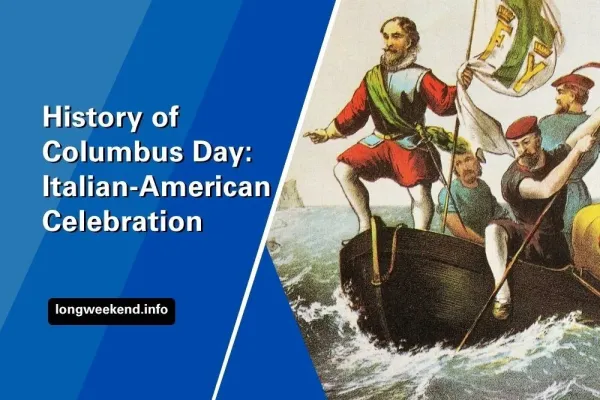
How Columbus Day developed from early commemorations of Christopher Columbus into a U.S. federal holiday, and why the October observance has different meanings today.
What Is Columbus Day?
Columbus Day is a U.S. federal holiday observed on the second Monday of October. It commemorates Christopher Columbus's 1492 voyage across the Atlantic and his arrival in the Caribbean on October 12, 1492.
The holiday, however, has a longer and more complicated history than its modern three-day-weekend association might suggest.
The observance developed over several centuries. Early American commemorations celebrated Columbus as an important figure in European exploration, while later celebrations became closely connected with Italian-American identity and the experiences of Italian immigrants in the United States.
By the 20th century, Columbus Day had become a widely recognized national observance, and in 1971 the federal holiday was moved from a fixed October 12 date to the second Monday of October.
At the same time, the historical understanding of Columbus and European colonization changed. Greater attention to the experiences of Indigenous peoples, including the Taíno and other Native communities of the Americas, led some communities and governments to adopt Indigenous Peoples' Day or another observance on the same October date.
As a result, the history of Columbus Day is not simply the story of one explorer. It is also a story about immigration, American identity, public commemoration, changing historical scholarship, and the way societies decide which parts of their history to remember publicly.
When Did Columbus Day Begin?
The roots of Columbus Day celebrations in the United States go back much further than the federal holiday itself.
The Library of Congress identifies October 12, 1792, as the first recorded celebration of Columbus Day in the United States. The event took place in New York and was organized by the Society of St. Tammany, also known as the Columbian Order, to commemorate the 300th anniversary of Columbus's arrival in the Americas.
This early commemoration was not yet a national holiday. It was a local celebration taking place at a time when Americans were developing national symbols and historical traditions for the relatively young United States.
Over the following decades, Columbus gradually became an important symbolic figure in American public culture. Italian immigrants and Italian-American communities also began organizing celebrations connected with Columbus.
The Library of Congress notes that Italian Americans were regularly honoring Columbus by the 1860s. That connection would become particularly important as Italian immigration to the United States increased during the late 19th and early 20th centuries.
Why Was Columbus Important to Italian Americans?
The history of Columbus Day cannot be fully understood without considering the history of Italian immigration to the United States.
During the late 19th and early 20th centuries, large numbers of Italians came to the United States. Many encountered discrimination and social prejudice as they established communities and sought acceptance in American society.
Columbus, a navigator associated with Genoa, became an important cultural symbol for many Italian Americans.
Celebrating Columbus provided Italian-American communities with a figure they could connect to their heritage while also emphasizing their place within American society. This helps explain why Columbus Day developed a meaning that went beyond the historical anniversary of a voyage.
For many Italian Americans, the holiday became an occasion to celebrate ancestry, community, cultural contributions, and belonging in the United States.
The Library of Congress documents the role of Italian-American organizations and the Knights of Columbus in promoting Columbus celebrations and encouraging states to recognize October 12. Colorado became the first state to establish Columbus Day as a legal holiday in 1907, followed by New York in 1909.
This period was important because Columbus Day was developing from a series of local and community celebrations into a broader American observance.
Columbus Day and the 1892 Quadricentennial
A major turning point came in 1892, when the United States marked the 400th anniversary of Columbus's first voyage.
President Benjamin Harrison issued a proclamation recommending that Americans observe the anniversary. His proclamation portrayed Columbus as an important figure in the history of exploration and described him in highly favorable terms.
The anniversary prompted ceremonies, school programs, public events, and other commemorations throughout the country.
The 1892 commemoration was significant because it transformed Columbus from a figure remembered primarily through particular communities and historical traditions into a much more prominent national symbol.
The following year, Chicago hosted the World's Columbian Exposition, commonly known as the Chicago World's Fair. The exposition was explicitly associated with the 400th anniversary of Columbus's voyage and became one of the most important public celebrations connected with Columbus in the United States.
The period helped establish the imagery and public traditions that would influence Columbus commemorations for decades.
When Did Columbus Day Become a National Holiday?
Columbus Day gradually moved through several stages before becoming the federal holiday Americans recognize today.
In 1892, President Harrison issued a national proclamation calling for observance of the 400th anniversary. That did not make Columbus Day a permanent federal holiday.
During the early 20th century, states and communities continued adopting their own Columbus Day observances. Italian-American organizations, including the Knights of Columbus, played an important role in encouraging state recognition.
Colorado became the first state to establish Columbus Day as a legal holiday in 1907.
In 1934, President Franklin D. Roosevelt designated October 12 as Columbus Day through a presidential proclamation under authority provided by Congress. The federal government continued issuing annual proclamations for the observance during this period.
This distinction is important because the history is sometimes simplified by saying that Columbus Day became a federal holiday in 1937. The modern federal holiday status dates to 1971, when federal law established Columbus Day as a legal public holiday observed on the second Monday of October.
The earlier 1934 designation was an important step in the development of the national observance, but it should not be confused with the modern statutory federal holiday.
When Did Columbus Day Become a Federal Holiday?
The modern federal status of Columbus Day dates to 1971.
Before 1971, Columbus Day was associated with October 12. The federal holiday schedule was changed so that Columbus Day would be observed on the second Monday of October, creating a consistent Monday holiday.
The Library of Congress identifies 1971 as the year Columbus Day was designated the second Monday of October and notes that it has been celebrated as a federal holiday since then. The U.S. Office of Personnel Management also currently lists Columbus Day as a federal holiday observed on the second Monday in October.
This is why the date of Columbus Day changes from year to year.
For example:
- 2025: October 13
- 2026: October 12
- 2027: October 11
- 2028: October 9
The historical date associated with Columbus's arrival is October 12, 1492, while the modern U.S. federal holiday is observed on the second Monday of October. That distinction is one of the most common sources of confusion when people search for the history of Columbus Day.
Why Is Columbus Day Celebrated on a Monday?
Columbus Day was originally associated with October 12, regardless of which day of the week that date fell on.
The move to the second Monday in October was part of a broader change in the federal holiday calendar. Rather than having certain holidays fall on different weekdays every year, Monday observances created predictable three-day weekends.
This means Columbus Day now falls between October 8 and October 14, depending on the year.
In 2026, Columbus Day falls on Monday, October 12, meaning the federal holiday creates the familiar three-day weekend from Saturday, October 10, through Monday, October 12.
The Monday observance also explains why modern references to a "Columbus Day weekend" usually mean the October three-day weekend rather than the exact anniversary date.
What Happened on October 12, 1492?
To understand why October 12 became associated with the holiday, it is necessary to look back to Columbus's first Atlantic voyage.
Christopher Columbus sailed westward from Spain in 1492 with the goal of reaching Asia by traveling across the Atlantic. His expedition consisted of three ships: the Niña, Pinta, and Santa María.
On October 12, 1492, the expedition reached an island in the Caribbean. Columbus called the island San Salvador; its Indigenous name is commonly identified as Guanahani, although the precise modern identification of the island remains debated.
Columbus's arrival did not represent the discovery of an uninhabited continent. Indigenous peoples had lived throughout the Americas for thousands of years before European arrival.
The Smithsonian's National Museum of the American Indian emphasizes that Indigenous societies already had established communities, cultures, political systems, and histories throughout the Western Hemisphere.
The encounter instead marked a major moment in the history of sustained European contact with the Caribbean and, subsequently, the broader Americas.
Columbus and the Indigenous Peoples of the Americas
The historical record surrounding Columbus includes far more than exploration and navigation.
European contact brought profound changes to Indigenous societies in the Caribbean and throughout the Americas. Disease, warfare, enslavement, displacement, loss of land, and disruption of existing societies followed European expansion.
The National Museum of the American Indian describes the consequences of European contact as including devastating population loss, disruption of traditions, loss of lands, and enslavement.
The National Park Service also documents violent encounters between Columbus's expeditions and Indigenous Caribbean communities. At Salt River Bay in what is now the U.S. Virgin Islands, for example, Columbus's second voyage in 1493 resulted in an early recorded conflict between Europeans and Indigenous Caribbean people.
These parts of the historical record are important when discussing Columbus Day because they help explain why the holiday's meaning has changed over time.
The historical debate is not simply about whether Columbus made an important voyage. It also concerns what followed that voyage and how the consequences of European colonization should be represented in public commemorations.
Why Did Indigenous Peoples' Day Develop?
As historical scholarship and public discussion increasingly addressed the experiences of Indigenous peoples, some communities began reconsidering how the second Monday of October should be observed.
One alternative that developed was Indigenous Peoples' Day, which focuses attention on Indigenous peoples, their histories, cultures, survival, and continuing presence.
The Smithsonian's National Museum of the American Indian explains that Native people and their allies have played a role in establishing Indigenous Peoples' Day observances in various states and communities. It is observed on the second Monday of October in places that have adopted it.
One notable early example occurred in 1992, when Berkeley, California, began observing Indigenous Peoples' Day in connection with the 500th anniversary of Columbus's arrival. Other cities and states subsequently adopted similar observances or changed the name of their October holiday.
The movement has not produced one uniform national approach. Different states, cities, schools, and institutions use different names and observance policies.
For example, Alaska officially designated the second Monday in October as Indigenous Peoples Day in 2017 after earlier gubernatorial proclamations.
The result is a diverse national picture in which Columbus Day remains a federal holiday while some states and communities observe Indigenous Peoples' Day instead or use both names.
Is Columbus Day Still a Federal Holiday?
Yes. Columbus Day remains a U.S. federal holiday.
The federal holiday is observed on the second Monday of October. The U.S. Office of Personnel Management continues to list Columbus Day among the federal holidays, while USAGov identifies it as the second Monday in October.
However, a federal holiday does not mean every state or local government must observe it in exactly the same way.
USAGov notes that states and the District of Columbia may recognize their own holidays, including Indigenous Peoples Day. Consequently, the name used for the October observance, whether government offices close, and how the day is commemorated can vary depending on location.
This distinction is particularly useful for travelers and anyone trying to determine whether a business, school, government office, or local attraction will operate normally on Columbus Day.
Columbus Day and Italian-American Heritage
For many Italian Americans, Columbus Day continues to have a cultural meaning that is connected to heritage rather than solely to Columbus's historical voyage.
The holiday's development coincided with a period when Italian immigrants were establishing communities across the United States and seeking recognition within American civic life. Columbus became an identifiable symbol of Italian heritage, and organizations representing Italian Americans helped establish and maintain public celebrations.
Parades remain one of the most visible examples of this tradition. New York's Columbus Day celebrations, for example, developed into a major annual event involving Italian-American organizations and community groups.
The Library of Congress records a 1909 New York parade led by Governor Charles Evans Hughes that included Italian-American societies and the crews of Italian ships.
This cultural history is one reason Columbus Day cannot be understood solely as a celebration of a 15th-century voyage. Over time, it acquired an additional meaning within the history of immigration and Italian-American identity.
How Has Columbus Day Changed Over Time?
The meaning of Columbus Day has changed considerably since its earliest American commemorations.
In the late 18th and 19th centuries, Columbus was often presented through a celebratory narrative of exploration and national progress. The 1892 quadricentennial strengthened this image through public ceremonies, monuments, educational programs, and patriotic events.
During the early 20th century, Columbus Day also became increasingly connected with Italian-American cultural identity. State holidays, parades, schools, and community organizations helped establish the observance as part of American public life.
The federal government later standardized the holiday, first through national proclamations and eventually through the federal holiday system.
In more recent decades, historians, educators, Indigenous communities, and members of the public have placed greater emphasis on the consequences of European colonization and the experiences of Indigenous peoples. That has contributed to the growth of Indigenous Peoples' Day and to different approaches to the October holiday.
The result is that Columbus Day has accumulated several layers of meaning rather than having one universally shared interpretation.
Columbus Day and the 1992 500th Anniversary
The 500th anniversary of Columbus's first voyage in 1992 became another major turning point in public discussion.
The anniversary generated large-scale commemorations of Columbus's voyage, but it also prompted renewed attention to the Indigenous peoples who were already living in the Americas before European arrival.
The National Museum of the American Indian holds archival material relating to the 1992 500th anniversary, reflecting the importance of the event in the history of Indigenous activism and public discussion.
The anniversary therefore had two distinct dimensions. It encouraged celebrations and historical commemorations of Columbus's voyage while also bringing greater public attention to the consequences of European contact.
This helped broaden the conversation around the October holiday and contributed to the continuing development of alternative observances.
Columbus Day Today: One Date, Different Observances
Today, the second Monday of October can represent different things depending on where someone lives and which community or institution they are part of.
At the federal level, the holiday remains Columbus Day. Federal agencies recognize it as one of the official federal holidays.
Elsewhere, the same date may be called Indigenous Peoples' Day, while some communities observe both Columbus Day and Indigenous Peoples' Day. Others may not recognize either as a state or local holiday.
Some Italian-American communities continue to organize Columbus Day parades and heritage celebrations. Indigenous communities and their allies may use the date to highlight Native histories, cultures, sovereignty, resilience, and contemporary life.
These observances reflect different historical experiences and priorities, which is why there is no single nationwide way to describe what the second Monday in October means to every American.
Columbus Day Timeline
Understanding the major dates makes the evolution of the holiday easier to follow.
1492: Christopher Columbus's first Atlantic voyage reaches the Caribbean on October 12.
1792: The Society of St. Tammany organizes a recorded U.S. commemoration of the 300th anniversary in New York.
1860s: Italian Americans increasingly organize Columbus celebrations as part of community and cultural life.
1892: President Benjamin Harrison issues a proclamation encouraging nationwide observance of the 400th anniversary.
1907: Colorado becomes the first state to establish Columbus Day as a legal holiday.
1909: New York establishes Columbus Day as a holiday and holds a major public celebration.
1934: President Franklin D. Roosevelt designates October 12 as Columbus Day under congressional authority.
1971: Columbus Day becomes a federal holiday observed on the second Monday of October.
1992: The 500th anniversary of Columbus's first voyage prompts both major commemorations and increased public discussion about Indigenous history.
2010s–2020s: More states, cities, and communities adopt Indigenous Peoples' Day or other October observances while Columbus Day remains a federal holiday.
2026: Columbus Day falls on Monday, October 12.
The History of Columbus Day Is Also a History of Changing American Memory
The history of Columbus Day stretches from an 18th-century anniversary ceremony to a modern federal holiday with different meanings across the United States.
Columbus's 1492 voyage remains the historical event at the center of the observance, but the holiday itself developed much later. Its history includes the 1792 commemoration in New York, the nationwide celebrations surrounding the 1892 quadricentennial, the role of Italian-American communities in establishing Columbus as a cultural symbol, state-level recognition in the early 20th century, federal action in the 1930s, and the creation of the modern federal holiday in 1971.
It also includes a growing recognition of the Indigenous peoples who were already living throughout the Americas and whose histories were profoundly affected by European expansion. That broader historical understanding has contributed to the adoption of Indigenous Peoples' Day in some parts of the country.
For anyone trying to understand Columbus Day today, the most useful approach is therefore to look beyond the familiar October date. The holiday is part of a much larger American story involving exploration, immigration, cultural identity, Indigenous history, public commemoration, and the way historical narratives change over generations.
Frequently Asked Questions About Columbus Day
When was the first Columbus Day celebration in the United States?
The first recorded U.S. celebration took place on October 12, 1792, in New York. It was organized by the Society of St. Tammany to commemorate the 300th anniversary of Columbus's arrival in the Americas.
When did Columbus Day become a federal holiday?
Columbus Day became part of the federal holiday calendar in 1971, when federal law established it as a holiday observed on the second Monday of October. Earlier national proclamations and state holidays had already established a long tradition of observing Columbus Day.
Why is Columbus Day celebrated in October?
October is connected to October 12, 1492, the date traditionally associated with Columbus's arrival in the Caribbean. Since 1971, the federal holiday has been observed on the second Monday of October rather than always falling on October 12.
Is Columbus Day still a federal holiday?
Yes. Columbus Day remains listed as a U.S. federal holiday and is observed on the second Monday of October.
Is Columbus Day the same as Indigenous Peoples' Day?
They are not universally treated as the same observance. Columbus Day remains the federal holiday name, while some states and communities observe Indigenous Peoples' Day on the same date. Policies and terminology vary by location.
Why is Columbus Day important to Italian Americans?
Columbus became an important cultural symbol for Italian Americans during a period of substantial Italian immigration and discrimination in the United States. Italian-American organizations helped promote Columbus Day celebrations and state recognition of the holiday during the late 19th and early 20th centuries.
What is the date of Columbus Day in 2026?
In 2026, Columbus Day falls on Monday, October 12. It is the second Monday of October and therefore creates a three-day federal holiday weekend.